How to play super blitz online
This article discovers secrets of super blitz chess from people who played thousands of games over the internet and have very good results against world top chess players. Here you can find many thoughts on strategy and tactics of this chess “madness”. Super blitz is a type of time control where each side has 1-2 minutes for the entire game. Its rules differ in terms of strategy and tactics from the usual blitz game and, of course, rapid chess. It is a game with a permanent shortage of time.
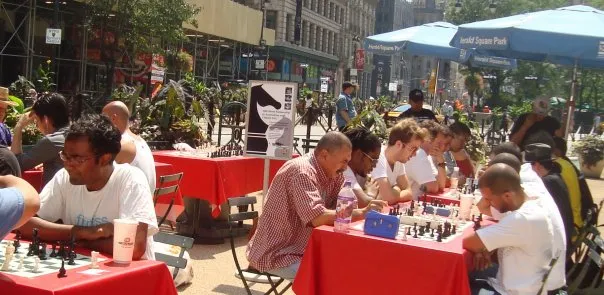
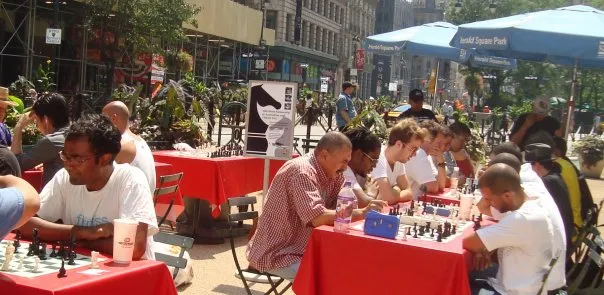 Playing blitz in a park
Many weak players usually call super blitz “antichess”, “perversion”, etc. However, it is just another type of chess, available only for advanced players who have thousands of blitz games in their asset. Please note, we do not recommend novice players to spend much time on it — it can greatly slow their improvement. What are the basic hardware requirements for it? For a successful play one should have a wide internet channel with a ping time to the game server of no more than 100 ms. We recommend setting a chess board to a medium size (10-15 cm) because it could increase move speed. And don’t forget to plug a high-definition optic mouse into your computer.
There are several possible strategies of super blitz chess we should mention.
In the first case one could force an opponent to make more “deliberate” moves, trying not to simplify the position, but rather complicate it, creating new threats, passed pawns, pins, etc. This behavior may force your opponent to search for a new game plan or defense, spending a lot of time. In another case you could play a home-prepared and well-studied middlegame schema. As a result of home preparation you may spend less time on each move.
What about some tips that could increase your chances during a game? There is a well-known rule that a time advantage during super blitz has the same value as a chess piece. So your task is to maximize time loss by an opponent. One of the best ways to do that is to play non-standard openings, rare variants and gambit continuations.
Or you can solve this problem from the other side — maximum saving of your own time. In this case it’s better to choose closed systems without pawn exchanges and with obvious moves. Try to play the game on different flanks. Your opponent will transfer attention from one flank of the board to another. It is a very time-consuming operation and requires high concentration. In some situations a player, in response to an opponent’s attack on the queenside, may organize a counterattack on the kingside.
The trickiest piece of chessmen is, of course, a knight — its moves could be unexpected. If you have more time and can repeat moves, repeat! But do not let a threefold repetition of position lead to a draw.
There are some tips on how to play against a weak player:
- Try to play in an attacking style
- As soon as possible open a pawn center and organize the attack on the King
- Use a massive pawns attack on the opponent’s King position, even by opening your own position
- If possible, do not exchange pieces — they are needed for attack
Keep in mind that a weak player can play much faster than you (doing up to 10 moves per second), but most of his moves would be weak and without a general plan. Therefore, it is important to develop a plan of attack as quickly as possible and to proceed with its implementation.
How to play blitz against a strong player:
- Play from the defense
- Play closed positions, do not exchange pawns
- Try to change pieces to go to the endgame
By selecting a closed system with a stable pawn chain, do not rush to make exchange moves. Pawns on the kingside are more vulnerable to attack than those in the center. If the level of strength of the players differs slightly, the side with the material advantage usually has less time — one player tries to realize a material (or at least positional) advantage, while the other tries to run down the opponent’s flag.
Tactics for the player realizing an advantage:
- Let an opponent make forced and defensive moves. In this case, you have full control over the chessboard and can quickly attack without thinking about the position of your own King.
- If, in your estimation, you can win by checkmate in the next 10 moves, play for the checkmate.
- When you don’t see an obvious checkmate, try to simplify the position, exchange pieces and create passed pawns. The fewer pieces your opponent has, the less he will resist, which means the faster you win. It’s better to spend a few moves destroying the enemy’s camp, and then quickly play for checkmate, than to just try to win without an obvious victory plan.
- In cases of wild time trouble (10-15 seconds or less before the end of a game), it’s best to exchange all pieces by any means guaranteeing at least a draw.
- Use simple checkmate techniques that don’t require much thinking.
Tactics in a worse position:
- When your position is worse and the other side has time trouble, change the goal: instead of protecting your position, try to run down the enemy’s flag. Spending too much time on defense is very expensive in super blitz chess. Try to put your pieces in an active position, where they have a large area of action.
- Give checks, especially with knights — your opponent has to defend, detracting from their own attack on your King.
- Actively advance pawns on the flanks, including trying to promote them to Queens. Active moves without a plan often bring down an opponent.
- When the other player has less than 10-15 seconds, use unexpected piece sacrifices and checks. The correctness of the sacrifice is irrelevant — the main thing is that the enemy wasn’t prepared for it.
In rare cases late in the game there is an obvious draw situation because of a lack of material. In this case it’s best to repeat moves, showing your opponent that you agree to a draw, and, if possible, offer one. In the end, try not to forget that blitz chess is just one way to have fun. Try not to take it too seriously.