Interview with GM Yuri Drozdovskij who recently won a tournament in India
Hi Yuri, thank you for agreeing to give an interview for GrossClub.com. As usual, you can tell us about things you haven’t been asked before — I think people will be interested.
How did you start playing chess, and why did you choose this sport?
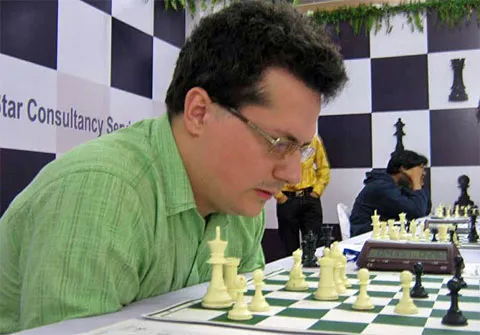 GM Yuri Drozdovskij
I was 6 years old when my brother explained the rules of chess to me. Since then my life has been inseparably connected with chess. At that age you don’t make an informed choice, you simply do what’s interesting.
We know you won the tournament in India. Tell us a little about the country.
I had been to India before. The experience is a mixed one — there’s enough poverty and dirt there, but the situation is improving. India is one of the most rapidly developing economies.
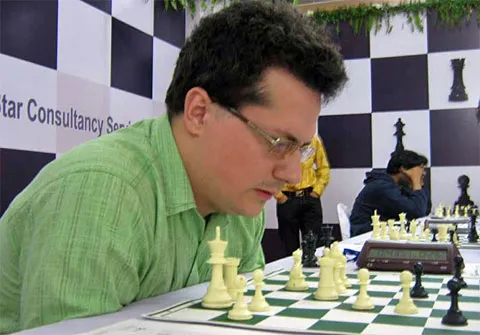
Chess is truly loved there! As the tournament winner, people asked me to take a photo with them, one after another — about 50 people! I can’t imagine that happening at European open tournaments. I also gave a huge number of autographs. I remember a girl who had cut out newspaper photos of every grandmaster, glued them into her notebook, and had us sign our own pictures.
The city of Bhubaneswar is sometimes called the City of Temples — there are about 500 of them, and we visited some of the most ancient. We could have seen more, but the average temperature of +45°C isn’t conducive to long walks.
What could help chess gain popularity? Any suggestions?
It would be extremely useful for chess to join the Olympic family. Something has been done toward that, but the road is long. Olympic sports receive a different level of state support in most countries.
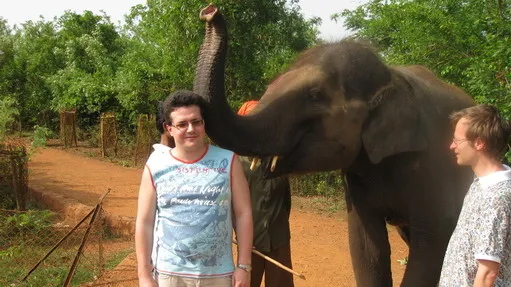 Yuri with GM Sergei Tiviakov
Which country would you recommend visiting? Tell us about your favorite.
Chess players usually travel a lot, and I’ve been to many countries — each is interesting in its own way. In India, for example, you can feel like a rich man with $100 in your pocket, which is a strange feeling for a European. In China, wherever you go, many people accompany you, and the most popular places are very crowded. Western Europe pleases with its friendly people and well-organized life.
In your opinion, which player will dominate the next 10 years?
In my opinion, the era of a single dominant player has passed. I think there will be a group of top players, and over the years this group will keep growing.
Do you have plans for future travel?
Yes — in August I’m going to Arctic Chess 2009 in Norway, and in October I’ll take part in the European Club Cup with the PGMB team.
On decision-making: is there a way to reliably win games against opponents rated much (300 points) below you?
There are some basic principles:
- Avoid underestimating your opponent — even a low-rated player can play like a grandmaster in a single game.
- Be well-prepared.
- Play with full energy, using every chance.
Is it hard to get a visa to Europe as an athlete? Is there a queue at the embassy?
Queues at the embassy are always the case. Whether you’re an athlete or not, you have to follow the usual procedure: contact the embassy well in advance (at least a month, usually more) for an interview, bring all the necessary documents, and wait at the embassy. I remember, a few years ago, one woman was taken away by ambulance — like the other visa applicants, she was standing on the street waiting her turn and got sunstroke.
In general, the situation is difficult, and we all look forward to Ukraine’s integration into Europe, when we can avoid this unpleasant visa procedure.
What car do you drive?
I don’t have a car. Traveling up to six months a year, I don’t think a car is necessary. It helps that, compared to Western Europe and the USA, taxis in Ukraine are quite cheap.
Is it possible to make a living just playing chess?
Earning money from chess alone is very difficult. Just playing strongly isn’t enough — you also need to be able to negotiate with organizers and club owners, and live in a cheap country. In general, it’s very difficult to make good money as a grandmaster rated below 2700. That’s why more and more chess professionals are becoming poker professionals.
Do you have a permanent coach? If not, would you like one?
I don’t have a permanent coach. Earlier, Karpov’s long-time assistant Mikhail Podgaets helped me periodically, but he recently passed away. Of course it’s easier to work with a coach, but at the moment I don’t think it’s necessary — I’m able to coach myself.
Yuri, thank you very much for the interview! We hope to see you here again.
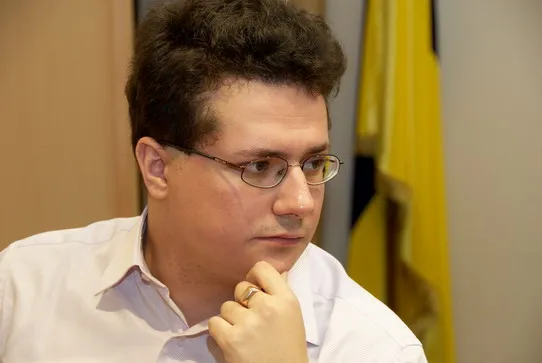 Yuri Drozdovskij