Anton Korobov gives an interview after winning Czech Open 2009
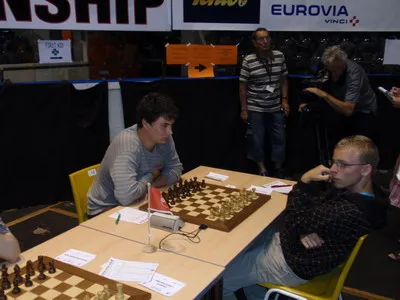
We remind readers that grandmaster Anton Korobov took clear first place with an impressive result of 8 out of 9 points in the recently completed Czech Open 2009 tournament in Pardubice. He kindly agreed to answer questions from the GrossClub.com audience.
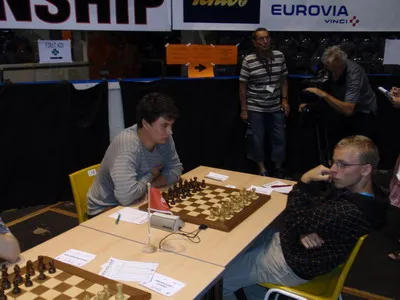 Final game of the tournament, Victor Laznicka - Korobov
What attracted you most in chess?
The process of cognition attracts me most, as well as — no matter how trivial it sounds — the opportunity to earn money. At times I can marvel at the beauty of ideas, but that’s very rare nowadays. As Mayakovsky wrote: sometimes a single word is worth tons of verbal ore. Well, the possibility — though occasional — of basking in glory is also not to be dismissed.
What do you think about chess game servers? Which do you prefer?
It gives me an opportunity to get an adrenaline rush without leaving the house. For many years I’ve played for the PGMB team in the “Chess Planet” playing zone. I also recently discovered “PlayChess”. In general, I think that an “overdose” of blitz on the internet leads to a degradation in real chess.
What helps you get into the right mindset for games?
The psychological attitude toward a game is a combination of listening to good music and calling myself naughty words. Music helps tune into the gaming wave; the other gives me a much-needed element of anger and aggression. So — arm yourself!
What are the main differences between chess professionals and amateurs?
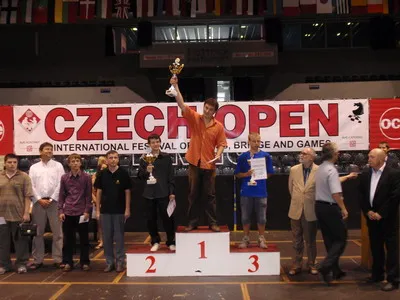 Grandmaster Anton Korobov at Czech Open
The difference mainly lies in the time that professionals and amateurs spend on chess. Another important factor: all the fans love chess, while among the professionals there are many who hate it.
It often happens in football that a good player, after his career, goes into coaching. Have you thought of this possibility for your own career?
I’ve never thought seriously about it, but it could happen in the future, I suppose. From personal experience I can say that “good player” is not synonymous with “good coach”. A coach needs a specific set of skills — being a good psychologist and educator, being able to put pressure on their student, and most importantly, having a huge understanding of chess. In short, that’s very rare nowadays.
What should chess players do primarily to improve?
It’s a very individual process and hard to generalize. Perhaps the ideal model of study is a synthesis of absorbing information and developing certain general principles. That’s all that comes to mind on this topic.
How many tournaments a year is best for you?
I’d say somewhere around six or seven per year. That gives an opportunity for full training and playing games. The perfect break between tournaments is around six weeks — enough time to rest, reflect on what happened, and prepare for new games. Of course there are other opinions; many grandmasters move from one tournament to another without any discomfort. The main drawback of that approach is the loss of freshness and clarity of thought, without which it’s impossible to play consistently and strongly.
What are your impressions of the Czech Republic?
The Czech Republic is a great country, with very good beer. Among the things that really impressed me, I can mention a few national dishes and the large number of strong players. The level of ecology, of course, is also very high.
Would you like to stay here to live, as you did 10 years ago?
But no one is offering! Life in the Czech Republic has advantages, at least in terms of the European passport, which doesn’t require multiple visits to embassies, standing in queues under the scorching sun or in terrible cold. Also, tournament conditions for players from Europe and other countries are simply incomparable. Moreover, state support for athletes in the Czech Republic is at a much higher level than in Ukraine, where athletes can only be proud of themselves.
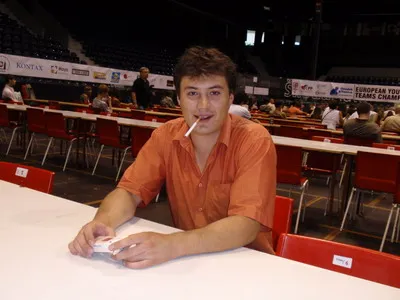 Anton Korobov in Pardubice
You played at the famous Danko club, where grandmasters such as Ponomariov, Karjakin, Efimenko, Areshchenko and Kuzubov also played. What useful things can be learned from dealing with these guys?
The atmosphere of competing with such “Fantomases” gives you wings. There were a lot of funny stories, but they’re not for the format of this interview.
We thank you for your interesting answers. We wish you further success on the international scene!
Date: 20.08.09