Interview with gm Anton Korobov after Aeroflot Open
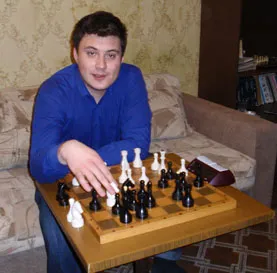
Grandmaster Anton Korobov from Ukraine is our guest today. In the recent Aeroflot Open 2010 he took clear second place.
What can you say about the Vietnamese chess players?
First of all, they have very common surnames. It was very difficult to prepare for Nguyen in the last round, as the computer’s search returned many namesakes — it was hard to identify my exact opponent just by name. It’s a very popular surname there, like Ivanov here. The Vietnamese players proved to be very solid and strong.
They’ve organized their work correctly. This may be due, first of all, to the presence of Evgeny Bareev, who works there on a permanent basis. It’s evident that they invest money in chess, and it produces results. They’re also very hard-working people.
How much time did it take you to prepare for each game?
Usually it takes me about 2 hours. The exception was the game against grandmaster Ivan Cheparinov — I had to prepare for him for about 3 hours. But preparation before the game against Arkadij Naiditsch took only 15-20 minutes. I understood that he would have to play fundamentally and aggressively, and would rely more on the game itself. He has a very wide opening repertoire, so it’s difficult to guess the variation, but as the course of events showed, I chose the correct concept. Anyway, Arkadij played Bg5, which was a surprise to me, since he had never played that way before, at least in the last 2 years.
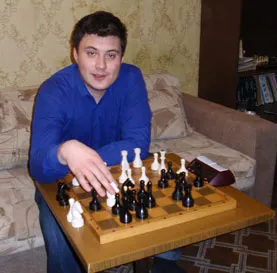 grandmaster Anton Korobov
What was your mood before the last round? Did you think about making a draw to secure a very good result?
Just before the round, my comrades from the Moscow PGMB club and I went to a Georgian restaurant near Chertanovskaya metro station, which I recommend to everyone. My accounting showed that I had to play to win — my mood was very militant. It was possible to ignore the financial factor and just play chess; one should only calculate income after the last round, according to my coach.
What about losing the game to gm Sergey Grigoriants?
I lost that game primarily due to a departure from a scientific approach. I rejected a proposed draw and started playing very aggressively, trying to “rip apart” the position, and when the smoke cleared I realized I was left with nothing. After move 40 I had to resign immediately.
Did your girlfriend help you?
She played a very important role — she gave me emotional stability. Half an hour of talking on the phone after a game, a little venting, and I’m ready again, like a new penny.
After which round did you gain confidence that you were in good shape?
I gained confidence after the second round. I lost one game, and any illusions that I must necessarily win the tournament disappeared. I found discipline and composure and a desire for a scientific approach to the game. I never stopped thinking about the result, but I managed to keep my play disciplined — without that, good results don’t happen.
On the Aeroflot Open participants.
Everyone made an impression on me. Vachier-Lagrave and Bacrot impressed me with their preparation — they clearly did a lot of work on chess and openings. I also have to mention the Vietnamese players — Le Liem impressed me with his structural integrity, and Nguyen with his tactical ingenuity.
About future plans.
I want to arrive in good shape for the European Championship. It will be a very decent tournament, with 60-70 players rated above 2600.
How does one get invited to a round-robin tournament?
You need to hold a very high rating for a long period of time, and sooner or later one of the organizers will send an email: “Could you find some time… how about coming to join our event?” And you can become a regular participant. Of course there are other ways too.
On the PGMB team.
I’m very grateful to Andrei and Sergei Maksimov Karpunkov for creating a good emotional atmosphere around me throughout the entire tournament. The team’s strength is primarily its internal spirit — the main requirement for chess success isn’t so much a high rating as it is the PGMB spirit.
About Moscow.
This time I wasn’t well prepared for the visit to Moscow. I had thought it would be good to practice some basic phrases a month or two before the trip, but it was hard to communicate with taxi drivers. The trip to the tournament and back took about 3-4 hours each day — a routine process.
How many hours do you spend on chess?
Eight hours a day.
About playing against computers.
It’s a necessary element to analyze some positions with a computer before a tournament. The analysis is also useful, but only in skilled hands — it should be properly structured and organized. It’s desirable to build a system: first independently study problematic positions and settle on your own, “biological” truth, and then compare it against the “silicon” truth.
About the Dutch Defense.
It’s quite viable, like the Leningrad variation. But in capable hands it’s possible to break through the wall. I want to learn it but haven’t had the time.
Did you watch House M.D.?
I haven’t seen this show before, but I’m going to watch it in the future.
Thank you for the interview — good luck, and see you at future tournaments!
Questions asked by members of Grossclub.
3.03.2010